










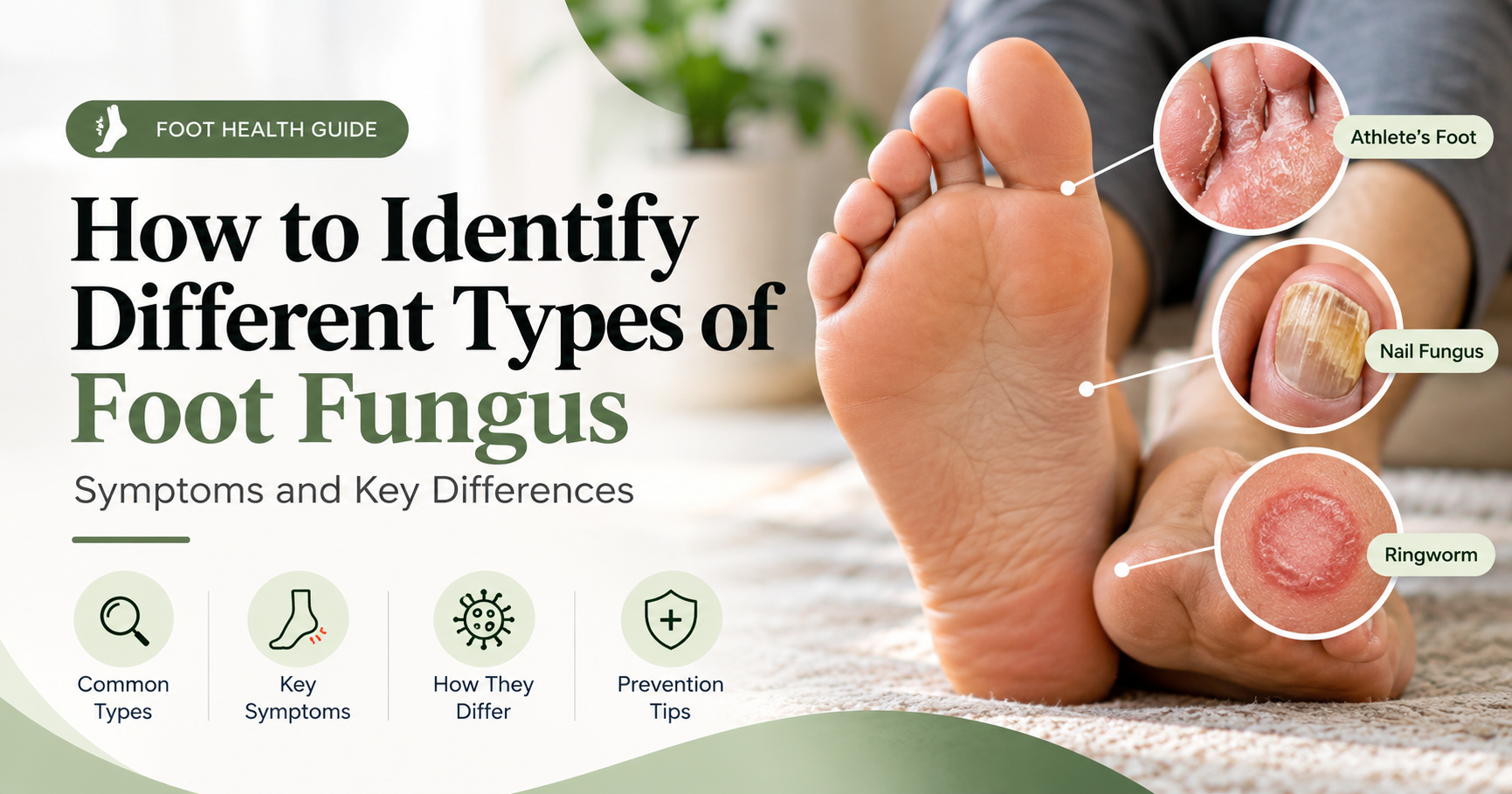
An itchy, peeling patch between your toes or a nail that is slowly turning yellow can be easy to ignore at first. Both are common signs of a fungal infection of the foot, and both tend to get worse when left alone. The tricky part is that foot fungus does not look the same in every person. It can appear as soggy skin, dry scale, small blisters or a thick, crumbling nail, and several other skin conditions can copy these signs.
This guide explains how to identify the different types of foot fungus, where each one usually appears, what it feels like, and which conditions are often mistaken for it. You will also learn how doctors confirm the diagnosis, which warning signs need prompt medical care, and how to lower the chance of getting the infection again.
- Most foot fungus is caused by dermatophytes, fungi that feed on keratin in skin and nails.
- The four patterns to know are toe-web (interdigital), moccasin-type, blistering (vesicular) and toenail fungus.
- Location and texture of the skin changes are the best clues to the type.
- Eczema, psoriasis, contact dermatitis and bacterial infections can look similar, so a test is the only sure way to know.
- People with diabetes, poor circulation or a weak immune system should see a doctor early.
What Is Foot Fungus?
Foot fungus is an infection of the skin or nails of the feet caused by fungi. When it affects the skin, doctors call it tinea pedis, better known as athlete’s foot. When it affects the nails, it is called onychomycosis. The most common culprits are dermatophyte fungi, although yeasts such as Candida and some moulds can also be involved, especially in nails.
These fungi thrive in warm, damp and dark places. Shoes and socks create exactly that environment, which is why the infection is so common. You can pick it up from damp floors in locker rooms, swimming pool surrounds, shared showers, hotel carpets or from sharing towels and footwear. It can also spread from one part of your own body to another, for example from the skin of the foot into a nearby toenail.
Where Foot Fungus Usually Appears
Different types of foot fungus tend to favour different areas. Use the map below as a starting point, then read the detailed descriptions in the sections that follow.
The Main Types of Foot Fungus and How to Recognise Them
1. Toe-Web (Interdigital) Athlete’s Foot
This is the most common form. It usually starts between the fourth and fifth toes, where the gap is tightest and moisture collects.
What to look for:
- Itching, burning or stinging between the toes, often worse when you remove your shoes
- Skin that looks white, soggy and macerated
- Peeling, cracking or small splits (fissures) in the skin fold
- Redness that may spread onto the top or underside of the toe
- A musty or unpleasant smell in some cases
The cracks can become entry points for bacteria. If the area becomes very red, swollen, painful or starts to ooze, a bacterial infection may have developed on top of the fungus.
2. Moccasin-Type (Dry, Scaly) Athlete’s Foot
This type is often mistaken for plain dry skin. It affects the sole, heel and sides of the foot in a pattern that resembles the area covered by a moccasin shoe.
What to look for:
- Dry, fine, silvery or white scale across the sole and heel
- Mild redness underneath the scale
- Thickened, rough skin and deep dry cracks on the heel
- Usually little or no itching, which is why it often goes unnoticed for years
- Often present on both feet, sometimes together with fungus in one hand (the “two feet, one hand” pattern)
Because it is stubborn and chronic, moccasin-type infection frequently needs longer treatment than toe-web infection, and sometimes prescription medicine.
3. Blistering (Vesicular) Athlete’s Foot
This is the least common type, and it can appear suddenly. It tends to affect the arch, the instep and the sides of the foot, but it can also show up between the toes.
What to look for:
- Clusters of small, fluid-filled blisters, often on the arch
- Strong itching or burning before and during blister formation
- Blisters that break, leaving moist patches and then crusts and scale
- Redness around the affected area
Because blisters on the feet have many possible causes, this type is the one most often confused with other conditions. Do not pop the blisters, as this raises the risk of bacterial infection.
4. Acute Ulcerative Athlete’s Foot
Some doctors describe a more severe form in which the toe-web infection breaks down into open, raw sores, often with a bacterial infection alongside the fungus. It can cause pain, swelling, discharge and sometimes a fever. This form needs medical attention rather than home treatment.
5. Toenail Fungus (Onychomycosis)
Toenail fungus develops slowly and is often painless in the beginning, so people notice it only when the nail has already changed shape or colour. Toenails are affected far more often than fingernails, and the big toe and little toe are common sites.
What to look for:
- A white, yellow or brown patch that starts at the tip or side of the nail
- A nail that gradually becomes thick and hard to trim
- Brittle, crumbly or ragged edges
- A nail that lifts away from the nail bed, with chalky debris underneath
- Distorted nail shape and, in some cases, a slight odour
- Discomfort when wearing shoes or pressure on the nail
Subtypes of nail fungus: Doctors describe a few patterns based on where the fungus enters the nail.
- Distal and lateral subungual: the most common pattern, starting at the tip or edge and moving toward the base, with thickening and yellow-brown discolouration.
- White superficial: chalky white spots or patches on the surface of the nail that can be scraped off.
- Proximal subungual: begins near the cuticle and spreads outward; this is less common and can be linked with a weakened immune system.
- Candida (yeast) infection: more often affects fingernails and nails with damaged skin around them, and may cause swelling and redness around the nail fold.
6. Yeast (Candida) Infection Between the Toes
Occasionally the cause is a yeast rather than a dermatophyte. It tends to look more bright red and shiny, with a moist surface and a ring of loose skin at the edge. It is more likely in people who spend long hours in wet conditions or who have diabetes. It looks similar to toe-web athlete’s foot, so only a test can separate the two.
Quick Guide: Match What You See to the Likely Type
Comparison Table of Foot Fungus Types
| Type | Common location | Appearance | Itch level |
|---|---|---|---|
| Toe-web (interdigital) | Between the 4th and 5th toes | White, soggy, peeling, cracked skin | Moderate to strong |
| Moccasin type | Sole, heel and sides | Fine dry scale, thickened skin | Mild or none |
| Vesicular | Arch and instep | Small fluid-filled blisters | Strong |
| Acute ulcerative | Toe webs | Raw, open, painful sores | Variable, often painful |
| Toenail fungus | One or more toenails | Thick, discoloured, brittle nail | Usually none, may be tender |
| Candida | Toe webs | Shiny red, moist skin | Moderate |
Conditions That Look Like Foot Fungus
Not every itchy, scaly foot is a fungal infection. Studies of people who were treated for presumed athlete’s foot show that a large share did not actually have a fungus when tested. Using an antifungal cream on the wrong condition wastes time and can irritate the skin further.
| Condition | How it can differ from fungus |
|---|---|
| Eczema (including dyshidrotic eczema) | Often has a personal or family history of allergies; blisters on the sides of the toes or soles; may affect both feet and hands; does not respond to antifungals. |
| Psoriasis | Well-defined thick red patches with silvery scale; may appear elsewhere on the body; nail pitting is common. |
| Contact dermatitis | Follows contact with a new shoe, sock material, glue or cream; the rash often matches the shape of the shoe. |
| Bacterial infection (erythrasma, pitted keratolysis) | Reddish-brown patches in skin folds or pitted, smelly soles; needs antibacterial treatment. |
| Nail injury or trauma | Usually affects one nail after a known knock or tight shoes; discolouration may be dark and grows out with the nail. |
| Other nail disease | Psoriasis, lichen planus and some medicines can thicken or change nails in ways that resemble fungus. |
How Doctors Confirm a Fungal Infection
A doctor may suspect foot fungus just by looking at it, but confirmation is especially useful for nails and for infections that keep coming back. Common tests include:
- Skin scraping with a KOH test: a small sample of scale is dissolved in a special solution and checked under a microscope for fungal elements.
- Fungal culture: a sample is grown in a laboratory to identify the exact organism. This can take several weeks.
- Nail clipping test: a clipping or debris from under the nail is examined with special stains or sent for culture or molecular testing.
- Wood’s lamp or dermoscopy: sometimes used to support the diagnosis in specific cases.
General Treatment Options
Treatment depends on the type and how widespread the infection is. The list below is a general overview and not personal medical advice.
- Toe-web and mild skin infection: non-prescription antifungal creams, sprays or powders containing ingredients such as terbinafine, clotrimazole, miconazole or tolnaftate are commonly used. They should be applied according to the label and often continued for some time after the skin looks normal.
- Moccasin type or widespread infection: stronger prescription creams or tablets are often needed.
- Vesicular type: the antifungal treatment is similar, but a doctor may also advise soothing measures for the blisters.
- Toenail fungus: nail infections are difficult to clear because the fungus lives under and inside the hard nail. Options include prescription oral antifungals, medicated nail lacquers or procedures chosen by a doctor. Nails grow slowly, so it can take many months to see a clear nail again.
- You have diabetes, poor circulation, nerve damage in the feet or a weakened immune system.
- The skin is very red, hot, swollen or painful, or you see pus or red streaks.
- You have a fever with a foot rash.
- Home treatment has not helped after about two weeks for skin, or the infection keeps returning.
- A nail is painful, or you are unsure whether the changes are fungal.
How to Prevent Foot Fungus
- Dry your feet well, especially between the toes, after bathing or swimming.
- Change your socks daily, or more often if your feet sweat. Moisture-wicking fabrics such as wool blends and synthetic sports socks help keep skin dry.
- Rotate your shoes and let each pair dry fully for at least a day before wearing it again.
- Wear sandals or shower shoes in locker rooms, public showers and around pools.
- Do not share towels, nail clippers, socks or shoes.
- Treat all affected areas together, including nails, so the fungus does not keep reinfecting the skin.
- Keep nails short and clean, and disinfect clippers after use.
- Use an antifungal powder in shoes if you are prone to repeat infections.
Foot-Care Products Worth Considering
While the right treatment depends on the type of infection, these product categories are commonly used for care and prevention:
- Over-the-counter antifungal creams and sprays for skin infections
- Medicated nail lacquers for mild nail changes
- Antifungal foot powders for shoes and feet
- Moisture-wicking and breathable socks
- Shower sandals for public wet areas
- Shoe dryers or deodorising inserts to help footwear dry out
Frequently Asked Questions
How can I tell if my foot problem is fungus or just dry skin?
Dry skin is usually even and improves with moisturiser. Fungus often has a clear edge, scale that returns, itching between the toes, or a sock-like pattern on the sole. If a moisturiser does not help after a couple of weeks, it is worth getting checked.
Is foot fungus contagious?
Yes. It spreads through direct contact and through shared damp surfaces, towels and footwear. Keeping your own towels and wearing shoes in shared wet areas lowers the risk.
Can foot fungus go away on its own?
Mild cases sometimes improve, but most do not clear fully without treatment and can spread to the nails or other parts of the body.
How long does toenail fungus take to clear?
Because nails grow slowly, a toenail can take about 12 to 18 months to grow out completely, even when treatment works well.
Can I have more than one type at the same time?
Yes. It is common to have toe-web infection along with moccasin-type scaling or a fungal nail. Treating only one area often leads to reinfection from the other.
When is foot fungus an emergency?
Seek urgent care if you notice spreading redness, severe pain, pus, red streaks up the leg or a fever, particularly if you have diabetes or a weak immune system.
Final Thoughts
Learning how to identify the different types of foot fungus helps you act sooner and choose the right next step. Soggy, peeling skin between the toes points to toe-web infection, dry scale across the sole suggests the moccasin type, clusters of blisters on the arch suggest the vesicular type, and thick, discoloured nails suggest onychomycosis. Because look-alike conditions are common, a simple skin or nail test is the most reliable way to be sure before starting long treatment.
Keep your feet clean and dry, protect them in public wet areas and do not ignore changes that last more than a couple of weeks. Early care is usually simpler, faster and cheaper than treating a long-standing infection.
Medical disclaimer: This article is for general information only and is not a substitute for professional medical advice, diagnosis or treatment. Always consult a qualified healthcare provider about any health concern.