





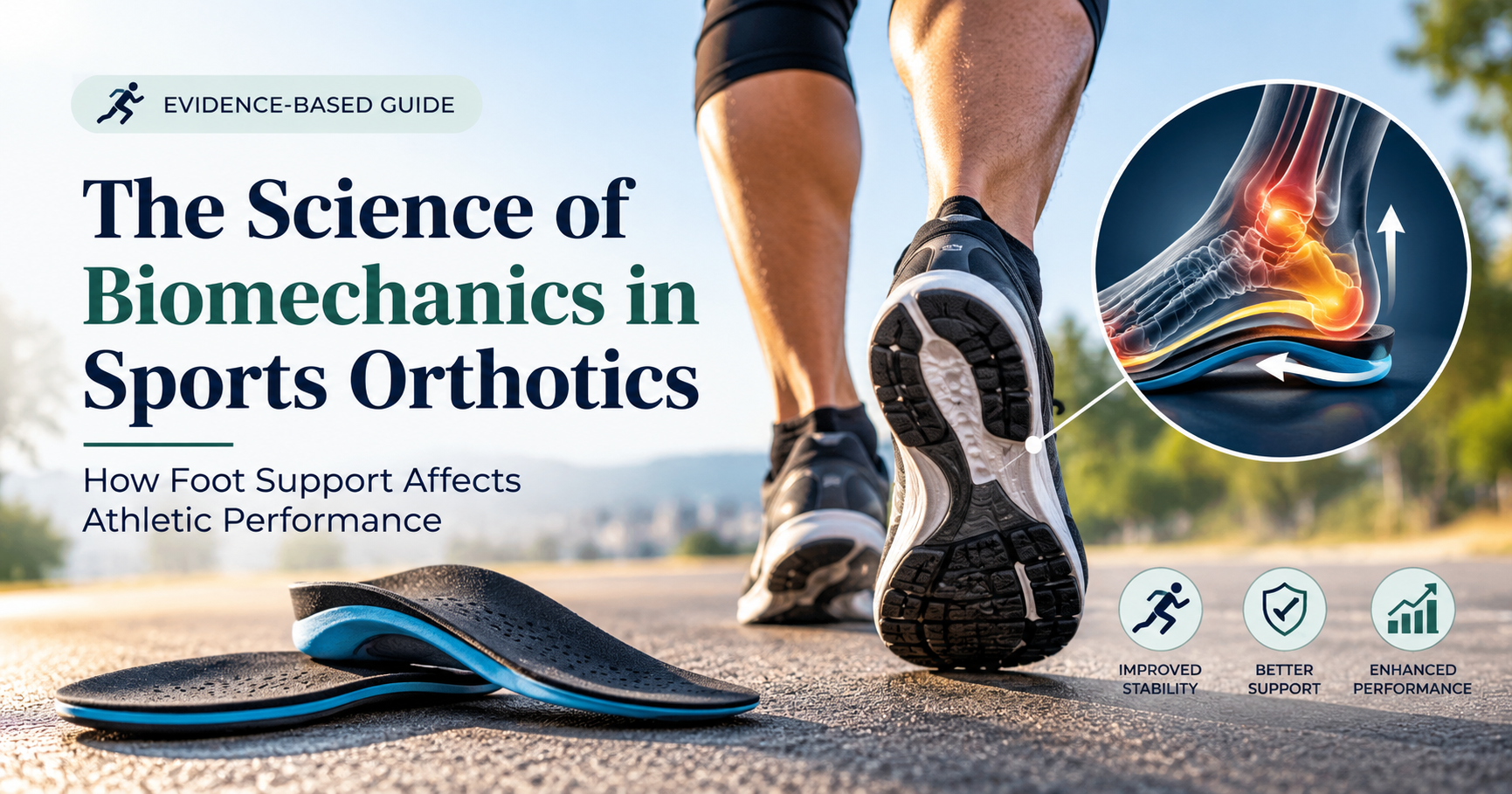

Every step, jump and cut you make sends force through your feet. Over thousands of repetitions, small differences in how that force is absorbed and redirected can decide whether you stay comfortable and perform well or end up with an aching heel, a sore knee or a nagging stress injury. This is where biomechanics meets sports orthotics.
Sports orthotics are often sold with bold promises, so it helps to know how they really work. This guide explains the science of biomechanics in sports orthotics in plain language: how the foot moves, what forces act on it, how orthotics change those forces, what the research says about their benefits, and how to match an orthotic to your sport and your body.
What Is Biomechanics?
Biomechanics is the study of how forces act on the body and how the body moves in response. In sport, it looks at questions such as how hard your foot hits the ground, how quickly your joints rotate, how your muscles share the load, and how much energy is stored or lost along the way.
For the foot and lower leg, biomechanics focuses on a few core ideas:
- Ground reaction force: The ground pushes back with the same force your body applies to it. In walking this is a little above body weight, while in running it can reach about two to three times body weight, and more in jumping.
- Loading rate: How quickly force builds up. A faster rise can place more stress on bone and soft tissue.
- Joint motion: The angles and rotations that occur at the ankle, knee and hip as you move.
- Muscle and tendon work: How the body controls, absorbs and returns energy.
- Tissue stress: The load that bones, tendons and ligaments carry compared with their capacity to cope.
The Foot as a Biomechanical Structure
The human foot is a complex, adaptable structure with 26 bones, 33 joints and a network of muscles, tendons and ligaments. It has two jobs that seem to conflict. At landing it must be flexible enough to absorb shock and adapt to the surface. At push-off it must become stiff enough to act as a lever.
The arches
The arches work like a spring. They flatten slightly as you load them and recoil as you push off, which stores and returns a share of the energy of each step.
The plantar fascia and the windlass mechanism
The plantar fascia is a thick band of tissue running along the sole from heel to toes. When the toes extend at push-off, the band tightens and raises the arch. This is called the windlass mechanism, and it helps stiffen the foot at the right moment.
Pronation and supination
Pronation is a natural inward rolling of the foot that helps absorb shock. Supination is the opposite motion, which stiffens the foot for push-off. Both are normal and necessary. Problems usually arise from too much, too little or poorly timed motion, rather than from pronation itself.

The Kinetic Chain: Why Foot Mechanics Matter Higher Up
The body behaves like a linked chain. The foot is the first link that meets the ground, and the way it moves can influence the ankle, knee, hip and even the lower back. For example, the shin rotates inward as the foot pronates, and that rotation can influence how the kneecap tracks. The effect works both ways, since hip and core control also affect how the foot lands.

This is the main reason orthotics are used in sport. A change at the base of the chain may alter how stress is shared along the whole leg. It is also why orthotics are not a cure-all: a problem that begins at the hip or from training errors will not be solved at the foot alone.
How Sports Orthotics Work: The Biomechanical Principles
Orthotics do not rebuild a foot or permanently realign bones. Research suggests they act more subtly, by changing how load is distributed and how the body feels. The main mechanisms are:
1. Redistributing pressure
A contoured orthotic increases the contact area under the foot, which spreads pressure over a larger surface instead of concentrating it at the heel and forefoot. Lower peak pressure at sore spots can reduce discomfort and tissue stress.
2. Supporting the arch and plantar tissues
Arch support can limit how much the arch flattens, which may reduce strain on the plantar fascia and related structures. This is one reason orthotics are widely used for arch and heel pain.
3. Influencing foot and leg motion
Posting wedges and firm shells can modestly change the timing and size of rearfoot and shin rotation. Studies generally find these changes are small and vary from person to person.
4. Attenuating shock
Cushioning materials can lower the peak impact felt at landing. Their effect on injury risk is less clear than their effect on comfort, since the body also adjusts its muscle activity to the shoe.
5. Improving comfort and sensory feedback
A leading theory is that the body prefers a comfortable movement path. An orthotic that feels comfortable may help the muscles settle into an efficient pattern and reduce effort. This helps explain why comfort is such a strong predictor of whether an orthotic works for a given person.
6. Offloading specific tissues
Features such as a metatarsal pad or a heel cup are designed to shift load away from a painful or vulnerable area and toward tissue that can tolerate it better.
Anatomy of a Sports Orthotic
Understanding the parts of an orthotic helps you read product descriptions and see which features match your needs.

- Heel cup: A cupped shape that holds the heel fat pad in place and improves stability.
- Arch support: A raised section that supports the midfoot. Height and firmness vary widely.
- Posting: A wedge at the inner or outer edge that biases foot motion. It is usually found in prescribed or more advanced designs.
- Metatarsal pad: A small dome behind the ball of the foot that offloads the forefoot.
- Top cover: The surface layer that handles friction, moisture and comfort.
- Shell: The base layer that gives the orthotic its shape and stiffness.
Materials and Their Biomechanical Properties
| Material | Feel | Biomechanical role | Best use |
|---|---|---|---|
| EVA foam | Light, moderately soft | Cushioning and mild support | Everyday and running |
| Polyurethane foam | Resilient, durable | Good shock absorption that holds its shape | High-mileage training |
| Polypropylene | Firm, semi-rigid | Stable shell that limits excess motion | Court and field sports |
| Carbon fiber | Very stiff, thin | Lever stiffness with low weight | Cycling and performance use |
| Cork | Firm yet slightly responsive | Stable support that molds over time | Hiking and general sport |
| Gel | Soft, plush | Local cushioning at heel or forefoot | Impact-heavy activities |
Types of Sports Orthotics
| Type | Description | Strengths | Limits |
|---|---|---|---|
| Prefabricated | Ready-made in standard sizes | Affordable, easy to find | General fit only |
| Heat-moldable | Softens in warmth to take foot shape | Better fit at moderate cost | Shape may not be exact |
| Custom-made | Built from a scan or cast of your foot | Tailored to your foot and sport | Higher cost, needs an assessment |
| Soft or accommodative | Cushioned, flexible | Comfort and pressure relief | Limited motion control |
| Rigid or semi-rigid | Firm shell with controlled flex | Stability and support | Takes time to adapt to |
Biomechanics by Sport
The ideal orthotic depends on the demands of your sport. Different activities create different loads, directions of motion and stiffness needs.

Running
Running is repetitive, with straight-line impact several times body weight. Cushioning and comfort are a high priority, along with enough support to keep the foot feeling stable late in a run when fatigue sets in.
Basketball and court sports
Court sports involve jumps, stops and sharp sideways movement. Lateral stability, a secure heel and good shock absorption matter most.
Soccer and field sports
Cleated footwear and fast direction changes call for a firm, thin, stable orthotic that fits snugly in narrow shoes and does not shift under load.
Cycling
In cycling, the foot pushes against a stiff pedal rather than the ground. Forefoot and arch support and stiffness help transfer power and reduce hot spots, while cushioning matters less.
Hiking and trail sports
Uneven terrain and long hours on the feet reward a supportive, durable orthotic with moderate cushioning and a stable heel.
Common Sports Injuries and the Role of Orthotics
| Condition | How load contributes | What orthotics may offer |
|---|---|---|
| Plantar fasciitis | Repeated strain on the plantar fascia | Short-term pain relief in many people when used with other care |
| Medial tibial stress syndrome (shin splints) | Repeated bone and muscle stress along the shin | May help some athletes as part of a broader plan |
| Patellofemoral pain | Altered knee tracking and load | Mixed evidence, may help some people |
| Achilles tendinopathy | Tendon overload | Support or heel raises may ease strain for some |
| Stress fractures | Cumulative bone loading | Cushioning and offloading as part of management |
| Forefoot pain | Pressure under the ball of the foot | Metatarsal pads and cushioning can reduce peak pressure |
What the Research Says: Benefits and Limits
The evidence on orthotics is balanced, and it is worth being honest about both sides.
- Where the evidence is encouraging: Orthotics often reduce pain for conditions such as plantar fasciitis in the short term, and many athletes report improved comfort.
- Where effects are modest: Measured changes in foot and shin motion are usually small, and they differ widely between individuals.
- Where the evidence is mixed: The ability of orthotics to prevent injury in healthy athletes is not firmly established, and results vary by study.
- Why comfort matters: People tend to do better with an orthotic they find comfortable than with one chosen purely on a foot measurement.
The takeaway is that orthotics are a useful tool, but not a magic fix. They work best when matched to the person, the sport and the problem.
Myths About Sports Orthotics
- Myth: Orthotics permanently correct flat feet. They support the foot while you wear them, but they do not rebuild the arch.
- Myth: Pronation is always bad. Pronation is a natural shock absorber. Only excessive or poorly timed motion is a concern.
- Myth: Stiffer is always better. Too much stiffness can feel harsh and reduce comfort.
- Myth: Custom is always better than prefabricated. Studies often find similar results for many common problems, so cost and comfort matter.
- Myth: Orthotics weaken the foot. There is little evidence of this, and foot strengthening exercises can be used alongside them.
How to Choose a Sports Orthotic
- Define your goal: Pain relief, comfort, stability or performance.
- Consider your sport: Match cushioning, stiffness and thickness to the activity.
- Check your shoe: Make sure there is room, ideally with a removable factory insole.
- Know your foot type: Higher arches often prefer more cushioning, while lower arches may prefer firmer support.
- Try before committing: Comfort is a strong guide, so choose one you can test or return.
- Get an assessment when needed: Persistent pain or complex problems deserve professional advice.
How to Break In and Care for Your Orthotics
- Start with one to two hours a day and build up over one to two weeks.
- Use them first in easy sessions, before a long run or a match.
- Expect mild, temporary adjustment sensations, but not sharp pain.
- Remove them and seek advice if pain increases or numbness appears.
- Clean with mild soap and water, and air dry away from direct heat.
- Replace them when the foam compresses, the top cover wears through or the support feels flat, which for active athletes is often within a year.
Buying Guide: What to Look for in Sports Orthotics
- Sport-specific design: Pick a product designed for your activity.
- Suitable thickness: It must fit in your shoe without crowding the toes.
- Durable, resilient materials: Foam that holds its shape lasts longer.
- Deep, supportive heel cup: Helps with stability.
- Breathable, moisture-wicking top cover: Important for hot, sweaty training.
- Size and arch options: Choose a range that matches your foot.
- Clear return policy: Fit is personal, so being able to swap is valuable.
When to See a Professional
- Pain lasting more than a couple of weeks
- Sharp, worsening or night-time pain
- Numbness, tingling or swelling
- Pain after a fall or injury
- A child or teenager with persistent foot pain
- Diabetes, circulation problems or reduced foot sensation
A professional can assess your gait and foot structure, and may use tools such as pressure mapping or video gait analysis to guide the choice.
Frequently Asked Questions
Do sports orthotics improve performance?
The evidence for direct performance gains is limited. The strongest benefit is better comfort and pain management, which can help you train consistently.
Can orthotics prevent injuries?
Evidence for prevention in healthy athletes is mixed. They are more commonly used to manage existing problems.
Are custom orthotics worth the cost?
They can be for complex or persistent problems. For many everyday needs, a good prefabricated or heat-moldable pair works well.
How long do sports orthotics last?
It depends on the material and your training volume. Many active people replace them every six to twelve months.
Can I use the same orthotics in all my shoes?
Often yes, if the shoes have similar fit and depth. Very different shoes, such as cleats and cushioned trainers, may need their own pair.
Should I wear orthotics all day?
Build up gradually. Many people wear them for sport and standing work, and take them out when they feel they no longer need them.
Do orthotics make the foot weak?
There is little evidence that they do. Adding foot and calf strengthening is a sensible complement.
Final Thoughts
The science of biomechanics in sports orthotics comes down to forces, motion and comfort. Orthotics work by spreading pressure, supporting tissue, modestly guiding motion and helping the body find a more comfortable pattern. They are not a cure-all, but for the right athlete and the right problem they are a practical, low-risk tool.
Match the orthotic to your sport, prioritize comfort, break it in gradually and combine it with good training habits. When in doubt, a professional assessment can save time and help you choose with confidence.
Affiliate disclosure: Some product recommendations on this site may earn a commission at no extra cost to you.