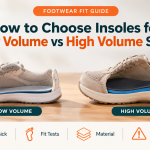

You found the perfect pair of shoes, added a pair of insoles, and suddenly your foot is squeezed, your heel is slipping, or your toes feel jammed. The problem is rarely the insole itself. More often, the insole does not match the volume of the shoe. Knowing how to choose insoles for low volume vs high volume shoes can save you money, blisters and a lot of frustration.
In this guide you will learn what shoe volume really means, how to tell which type you own, what thickness and materials work best for each, and how to test the fit before you commit.
What Is Shoe Volume?
Shoe volume is the total amount of empty space inside a shoe. It is not the same as shoe length or width. Two shoes in the same size and width can feel completely different because one has a tall, roomy interior and the other is slim and low.
Volume is made up of three main areas:
- Instep height: the space above the top of your foot, under the laces or tongue.
- Forefoot depth: the vertical room over your toes and the ball of your foot.
- Heel cup depth: how deeply the back of the shoe cradles your heel.
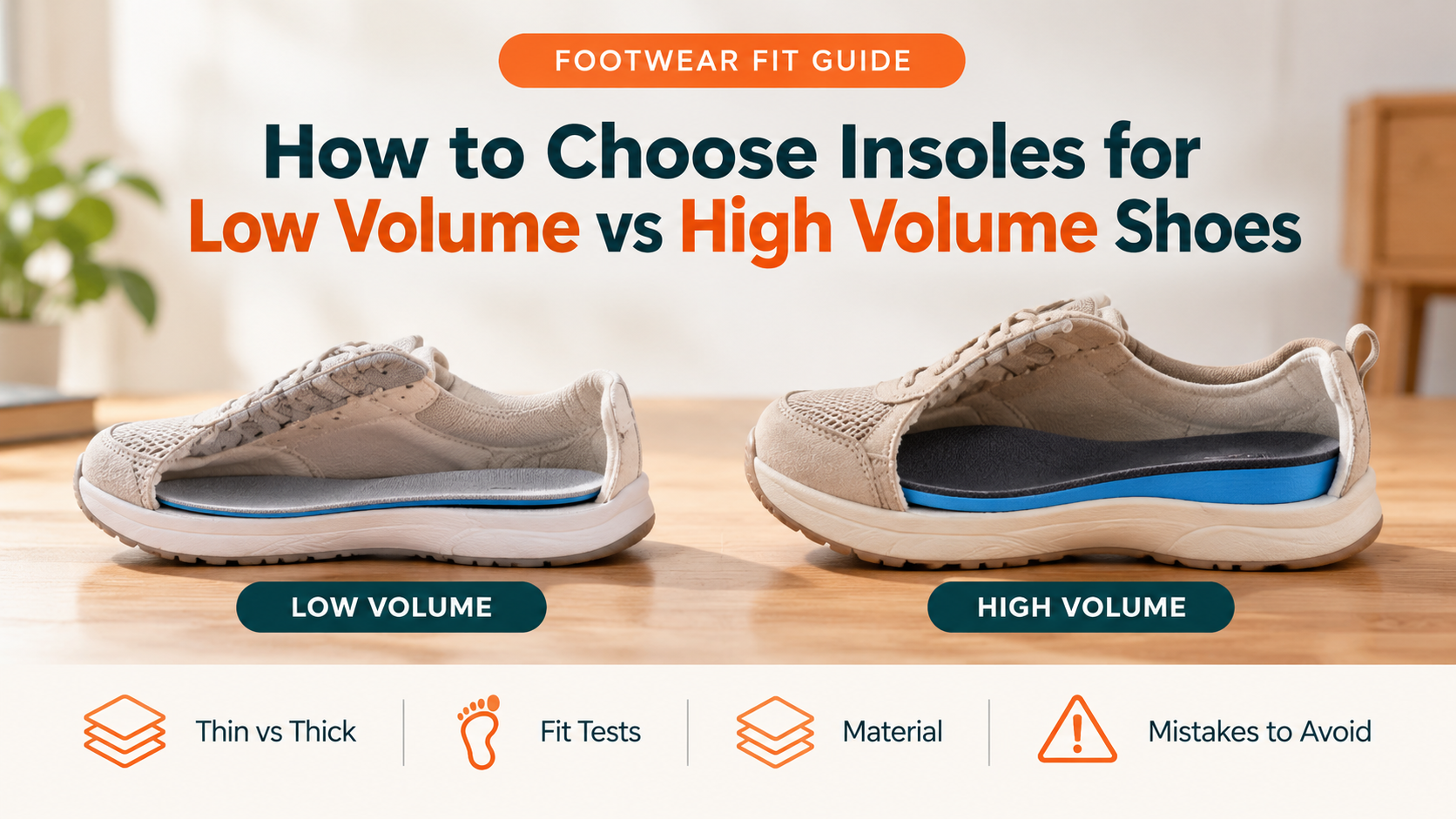
Low Volume vs High Volume Shoes

Low Volume Shoes
Low volume shoes have a shallow, tight interior. They hug the foot and leave little vertical room. Common examples include:
- Dress shoes and loafers
- Ballet flats and women’s pumps
- Football (soccer) cleats
- Cycling shoes and climbing shoes
- Lightweight racing flats and slim sneakers
High Volume Shoes
High volume shoes have a tall, generous interior with extra room above and around the foot. Examples include:
- Hiking boots and work boots
- Wide toe box running and walking shoes
- Thick, heavily padded trainers
- Many winter and insulated boots
- Orthopedic or diabetic footwear designed for extra room
Foot Volume Matters Too
Shoe volume is only half the equation. Feet also come in different volumes:
- Low volume feet: thin, flat or low in the instep, often with narrow heels. They tend to swim in standard shoes.
- High volume feet: high arches, tall insteps or thick forefeet. They often feel pressure on top of the foot in slim shoes.
A person with a high volume foot in a low volume shoe needs the thinnest insole possible. A person with a low volume foot in a high volume shoe needs an insole that fills space. Always consider both together.
How to Choose Insoles for Low Volume Shoes
The goal is support without stealing space. Every millimeter matters in a slim shoe.
- Pick a low profile design. Look for insoles around 2 to 3 mm at the thickest point, or thinner for very tight shoes.
- Consider 3/4 length insoles. They support the arch and heel but stop before the toes, which reduces bulk in the forefoot.
- Choose dense, thin materials. Thin cork, firm EVA, Poron-style foam and thin carbon or composite plates offer support without thickness.
- Check the heel cup. A very deep heel cup can lift your heel and cause slipping in a shallow shoe.
- Remove the factory sockliner. Replacing it with your new insole, instead of stacking both, keeps volume down.
- Make sure the insole can be trimmed. Cut-to-fit options let you match the exact outline of your shoe.
How to Choose Insoles for High Volume Shoes
Here the aim is to take up slack, stop your foot from sliding and add comfort.
- Go thicker. Insoles of 4 to 6 mm or more help fill extra space and hold the foot in place.
- Choose full-length insoles. They prevent bunching and keep the foot stable from heel to toe.
- Look for cushioning materials. Memory foam, PU foam and gel add comfort and take up space, which is great for long days on your feet.
- Pick a deeper heel cup. A deep cup locks the heel in place and reduces blisters.
- Add structured arch support. In roomy shoes, a firm arch helps your foot sit in the right position rather than rolling inward.
- Combine with other fixes if needed. Heel grips, tongue pads and slightly thicker socks work well together with a thick insole.
Quick Comparison Chart

| Feature | Low Volume Shoes | High Volume Shoes |
|---|---|---|
| Insole thickness | 2 to 3 mm or less | 4 to 6 mm or more |
| Best length | 3/4 length or thin full length | Full length |
| Best materials | Thin cork, firm EVA, Poron, composite | PU foam, gel, memory foam, dense EVA |
| Heel cup | Shallow to medium | Medium to deep |
| Main goal | Support without bulk | Fill space and stabilize |
| Common problem | Tight instep, heel lift | Slipping, blisters, toe jam |
Insole Types and Which Shoe Volume They Suit
- Cushioned comfort insoles: best for high volume shoes, especially for standing or walking all day.
- Arch support insoles: available in thin and thick versions. Choose the profile that matches your shoe volume.
- Sport performance insoles: often firm and moderately thin, suitable for running shoes with medium volume and cleats with low volume.
- Orthotic insoles: often thicker and more rigid. Many need a high volume shoe or removable factory insole to work properly.
- Cut-to-fit insoles: versatile for both types because you can trim them to the exact shape.
- Insulated insoles: usually thick, so they suit boots and high volume footwear.
The 4-Step Fit Test

- Remove the factory sockliner. Most shoes have a removable insole. Taking it out gives you the true interior volume.
- Compare shapes. Lay the new insole next to the old one. It should match closely in length and shape, and lie flat inside the shoe without curling.
- Stand up and check the heel. With laces tied, you should not feel your heel lift or slide. You should also feel no sharp pressure on the top of your foot.
- Walk for 10 minutes. Hot spots, numbness, toes hitting the front or a squeezed feeling mean the insole is too thick or too bulky. Slipping means it is too thin.
Tip: Try insoles on in the evening when your feet are slightly swollen. That is the most realistic fit.
Common Mistakes to Avoid
- Stacking insoles. Adding a new insole on top of the factory one adds height and often ruins the fit.
- Ignoring the arch type. The insole arch should match your foot, not just the shoe.
- Choosing by shoe size only. A size 10 insole may still be wrong if the shoe is slim or roomy.
- Buying thick insoles for dress shoes. This leads to heel slip and a pinched instep.
- Using thin insoles in big boots. Your foot will slide forward and cause blisters.
- Skipping the break-in period. Support insoles often need several days of gradual use.
What to Look for Before You Buy
- Clear thickness details in the product description, ideally in millimeters.
- Length options or trim lines for a customized fit.
- A heel cup depth that suits your shoe.
- Materials that fit your activity: firm for sports and support, soft for comfort.
- Moisture-wicking and antimicrobial top covers for shoes you wear for many hours.
- A return policy, since fit is personal and hard to judge online.
Frequently Asked Questions
Can I use the same insoles in low and high volume shoes?
Sometimes, but it is rarely ideal. A medium-thickness, cut-to-fit insole can work in both, though a thin insole in a roomy shoe will feel loose and a thick one in a slim shoe will feel tight.
How do I know if my shoe is low or high volume?
Slide your hand inside. If there is very little space above your foot and the shoe feels snug even without an insole, it is low volume. If you can easily fit extra padding and still lace comfortably, it is high volume.
Should I replace or add to the original insole?
Replace it in most cases. Removing the factory sockliner preserves space. Only add on top if the shoe is clearly roomy and you are filling a gap.
What if my foot has high volume but my shoes are low volume?
Use the thinnest firm insole available, consider 3/4 length, and look at shoes with adjustable lacing or more instep room. No insole can fix a shoe that is simply too small.
Do I need orthotics or regular insoles?
If you have pain, flat feet, plantar fasciitis or other foot conditions, speak with a podiatrist or physical therapist. Over-the-counter insoles suit general comfort and mild support needs.
How often should insoles be replaced?
Most insoles last 6 to 12 months with regular use. Replace them sooner if they flatten, crack, smell or no longer feel supportive.
Final Thoughts
The secret to choosing insoles is matching them to both your foot and the volume of your shoe. Go thin, low profile and trimmed for slim shoes, and thicker, cushioned and full length for roomy ones. Use the fit test, avoid stacking, and give your feet time to adjust. With the right match, even your tightest dress shoes and biggest boots can feel comfortable all day.
This article is for general information and is not medical advice. If you have persistent foot pain, consult a qualified healthcare professional.