
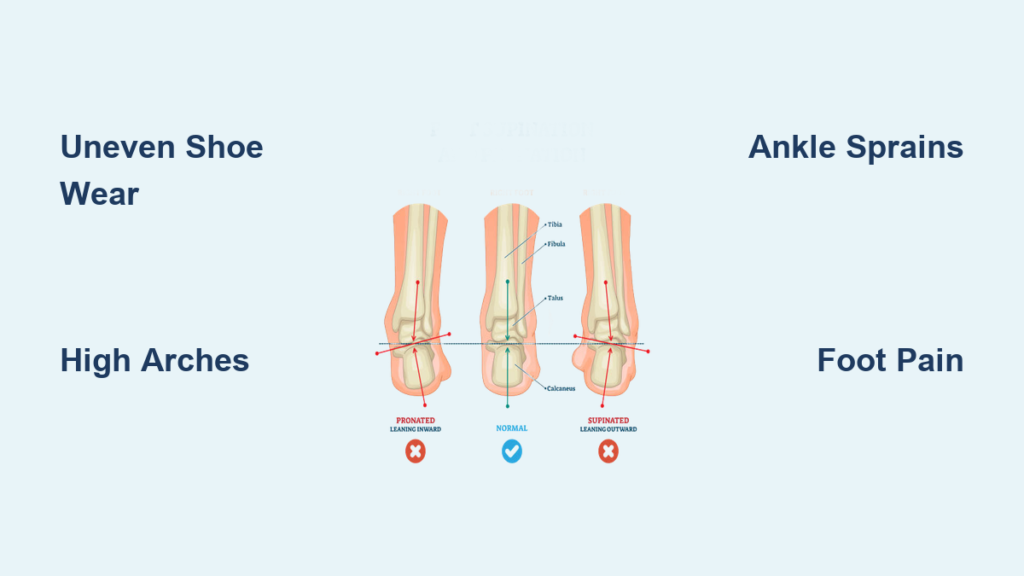
If your running shoes consistently wear out on the outer edges or you’ve rolled your ankle one too many times during routine activity, you may be experiencing excessive supination, also known as underpronation. This biomechanical imbalance occurs when your foot fails to roll inward enough after heel strike, leaving the outer edge to bear the brunt of impact. Without proper shock absorption, that force travels up your legs, increasing your risk for injuries in the feet, ankles, knees, hips, and even lower back.
Left unaddressed, supination can turn a simple jog into a painful ordeal, sideline athletes, and lead to chronic musculoskeletal problems. The good news? Early detection can prevent long-term damage. By recognizing the telltale signs—such as uneven shoe wear, high arches, frequent ankle sprains, and lateral foot pain—you can take action before discomfort escalates into injury. In this guide, you’ll learn how to identify excessive supination, understand its root causes, and discover proven strategies to correct it—so you can move with confidence, run safely, and stay active without pain.
Decode Your Shoe Wear Patterns
Check for Outer Sole Breakdown
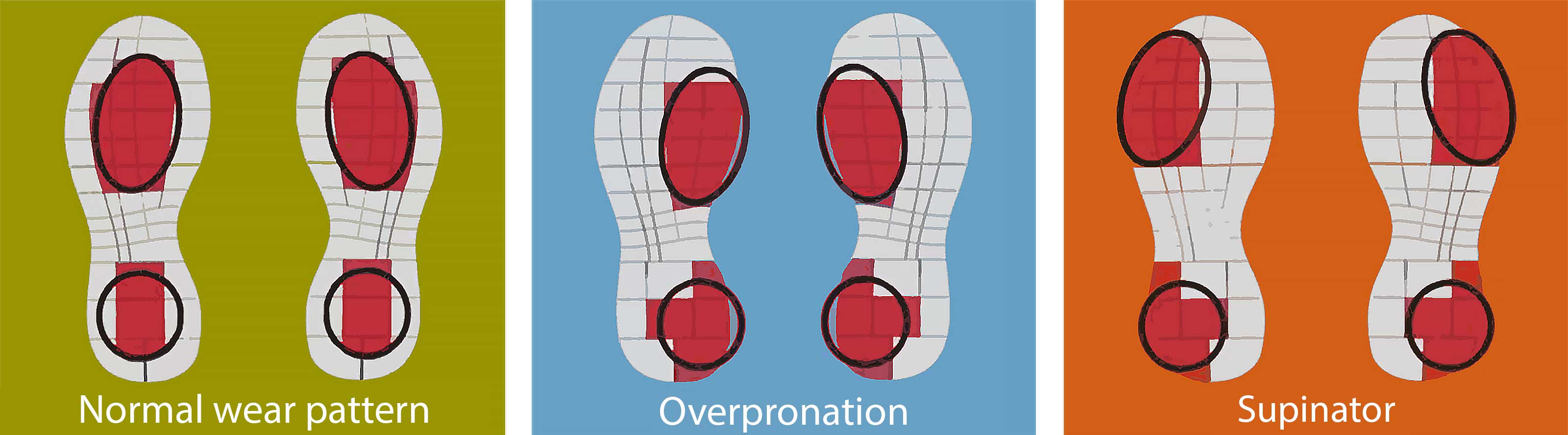
One of the clearest indicators of supination is abnormal wear on the lateral (outer) side of your shoe soles. If your running or walking shoes show significant tread loss along the outside edge—especially at the heel and forefoot—you’re likely underpronating. Unlike a neutral gait, where wear progresses diagonally from the outer heel toward the big toe, supinators leave a narrow, straight-line pattern along the outer margin.
Place your most-worn shoes on a flat surface. Do they tilt outward? That’s a strong sign of lateral weight dominance. Supinators often need to replace shoes every 200–300 km (125–185 miles) due to rapid breakdown of cushioning on the outer side—far sooner than the average runner.
Pro Tip: Rotate between two pairs of shoes to extend their lifespan and reduce repetitive stress patterns.
Why Lateral Wear Matters
This concentrated wear isn’t just cosmetic—it reflects how your body distributes impact. When the foot doesn’t roll inward properly, the lateral heel and 5th metatarsal absorb excessive force. Over time, this increases your risk for stress fractures, ankle sprains, and joint pain. Monitoring shoe wear gives you a real-world snapshot of your gait mechanics—no special equipment needed.
Identify High Arches (Cavus Foot)
Spot the Elevated Arch
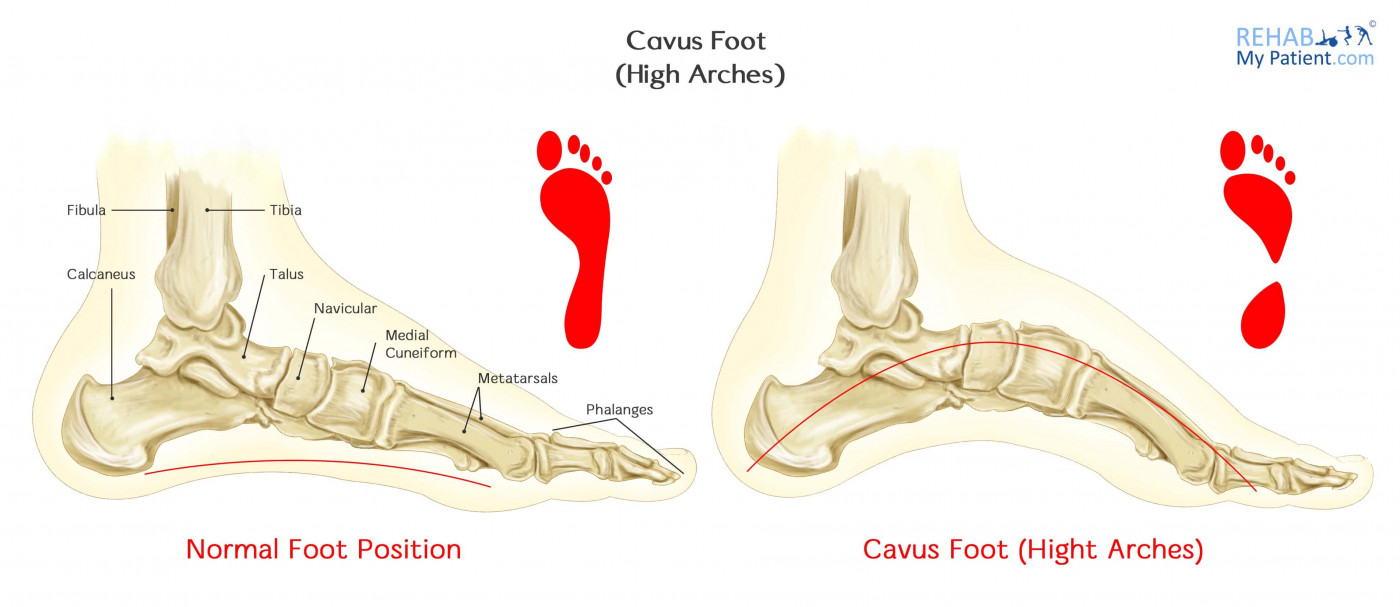
High arches—clinically known as cavus foot—are strongly linked to supination. If your medial longitudinal arch appears unusually raised, and only the heel and ball of your foot touch the ground when standing, you likely have a high-arched foot type. This structure limits the foot’s ability to pronate naturally, making it rigid and inefficient at absorbing shock.
Quick Test: Perform the wet footprint test. Wet your bare feet and step onto a dark surface like paper or concrete. If less than half of your arch shows contact—or only a thin strip appears—you’re likely a supinator.
How High Arches Affect Gait
Cavus feet are often inflexible, leading to poor force distribution during walking or running. Instead of a smooth transition from heel to toe, pressure stays locked on the outer edge and forefoot. This contributes to:
- Reduced ground contact area
- Increased peak pressure on the 4th and 5th toes
- Bouncy or unstable gait
While some people inherit high arches, others develop them due to neuromuscular conditions like Charcot-Marie-Tooth disease or cerebral palsy, which alter muscle balance in the lower limbs.
Watch for Recurrent Ankle Sprains
Lateral Instability Is a Red Flag
If you’ve rolled your ankle more than once—especially during simple movements like stepping off a curb—you may be dealing with chronic lateral instability, a hallmark of supination. Because weight concentrates on the outer foot, the ankle joint becomes vulnerable to inversion sprains, where the foot twists inward and overstretches the lateral ligaments.
Each sprain weakens proprioception (your body’s sense of joint position), creating a vicious cycle: instability leads to more sprains, which further degrade balance and control.
Who’s at Risk?
Athletes in sports requiring quick direction changes—like basketball, soccer, or trail running—are especially prone. But even casual walkers on uneven terrain can suffer repeated injuries if supination goes unchecked. If you frequently feel like your ankle “gives way,” it’s time to evaluate your foot mechanics.
Expert Note: Supination trauma refers to injury caused by excessive outward rolling of the foot—common in underpronators.
Feel for Outer Foot and Ankle Pain
Localized Discomfort on the Lateral Side
Persistent pain along the outside of the foot or ankle is a direct symptom of supination. You might feel tenderness under the 5th metatarsal head, near the cuboid bone, or around the peroneal tendons, which run behind the lateral ankle.
This pain often worsens during or after activity and may be mistaken for a sprain—even when no acute injury occurred. Over time, chronic pressure can lead to tendonitis, bone spurs, or joint inflammation.
Don’t Ignore Pressure Sores
High-pressure zones also produce calluses or corns on the outer heel and lateral forefoot. These thickened skin areas develop from repeated friction and are your body’s attempt to protect itself. In severe cases, they can become painful or even ulcerate, especially in individuals with reduced sensation.
Recognize Shin and Calf Problems
Shin Splints Linked to Poor Shock Absorption
Supinators frequently suffer from anterior shin splints (medial tibial stress syndrome), characterized by aching or sharp pain along the front outer side of the lower leg. Since the foot doesn’t absorb impact well, forces transmit directly up the tibia, overloading the muscles and bone.
Pain typically flares during running and may linger afterward. Ignoring it increases the risk of stress fractures, particularly in the fibula or metatarsals.
Tight Calves and Achilles Tendon
Tightness in the gastrocnemius, soleus, and Achilles tendon is both a cause and effect of supination. When these structures are stiff, they restrict ankle dorsiflexion (upward movement), forcing the foot into an externally rotated, supinated position.
Warning Sign: Morning calf tightness or Achilles pain could signal early tendinopathy—a degenerative condition that worsens without intervention.
Stretching these areas daily can significantly improve gait mechanics and reduce strain.
Diagnose Heel and Arch Pain
Plantar Fasciitis Isn’t Just for Flat Feet
Though often associated with overpronation, plantar fasciitis is also common in supinators. With high arches and rigid feet, the plantar fascia ligament—running from heel to toes—experiences increased tension and microtears.
Symptoms include:
– Sharp, stabbing heel pain with first steps in the morning
– Arch discomfort that improves slightly with movement
– Pain that returns after prolonged standing
Unlike flat-footed cases where the fascia is overstretched, supination creates excessive strain due to lack of flexibility and shock absorption.
How to Differentiate
If your pain is localized to the bottom of the heel and worsens after rest, plantar fasciitis is likely. Imaging isn’t always needed—diagnosis often comes from clinical history and physical exam. But if symptoms persist beyond 6–8 weeks, see a specialist.
Detect Stress Fractures Early
:max_bytes(150000):strip_icc()/x-ray-image-of-bone-fracture-at-5th-metatarsal-left-foot-945203958-ca2c136b313e4456b7f36e7058938d1b.jpg)
Fractures in the 4th and 5th Metatarsals
Due to poor shock dispersion, supinators are prone to stress fractures—tiny cracks in bones caused by repetitive loading. The 4th and 5th metatarsals (connected to the ring and little toes) are especially vulnerable because they bear disproportionate force during push-off.
Early signs include:
– Gradual onset of localized foot pain
– Swelling without bruising
– Pain that decreases with rest but returns with activity
Critical: These injuries are often missed on initial X-rays. MRI or bone scan may be needed for accurate diagnosis.
Fibula Fractures Also Occur
The fibula, the outer lower leg bone, can also develop stress reactions in supinators. Pain here may be mistaken for shin splints but is located higher—near the ankle or mid-calf.
Athletes and runners should monitor any persistent leg pain. Continuing activity without treatment can lead to complete fractures.
Trace Pain Up the Kinetic Chain
Knee, Hip, and Back Pain from Altered Mechanics
Supination doesn’t just affect the foot—it disrupts the entire kinetic chain. As the foot rolls outward, it forces the lower leg to rotate abnormally, altering knee alignment and hip stability.
Common downstream effects include:
– Iliotibial (IT) band syndrome: Sharp outer knee pain during running
– Lateral knee pain from increased joint compression
– Hip pain due to compensatory gait patterns
– Lower back pain from postural imbalances
Key Insight: If you’ve treated knee or back pain without success, the root cause may be in your feet.
A podiatrist or physical therapist can assess whether your supination is contributing to these seemingly unrelated issues.
Analyze Your Gait and Foot Strike
Spot Abnormal Running Form
Runners with supination often land on the outer heel or lateral forefoot, followed by minimal inward roll. This creates a bouncy, rigid stride with poor energy transfer.
Video gait analysis reveals:
– Lateral heel strike
– Limited midfoot pronation
– Concentrated pressure peaks on the 4th and 5th metatarsals
– Horizontal or L-shaped gait lines in pressure mapping
Some supinators compensate by adopting a forefoot strike, which shifts load to the calves and increases fatigue.
Fix Overstriding and Rotation
Overstriding—landing with the foot far ahead of the body—exacerbates supination. So does excessive external foot rotation during swing phase. Both reduce control and increase impact.
Fix: Shorten your stride, increase cadence (steps per minute), and aim for a midfoot landing centered under your body.
Choose the Right Footwear and Orthotics
Pick Shoes Designed for Supinators
Not all running shoes are created equal. Supinators need:
– Flexible, lightweight construction
– Ample cushioning, especially on the lateral side
– Straight or semi-curved last (shoe shape) to encourage inward motion
– Soft midsole to enhance shock absorption
Avoid motion-control or stability shoes—designed for overpronators—they’re too rigid and can worsen supination.
Top Picks: Look for models labeled “neutral” or “cushioned” from brands like Hoka, Brooks Ghost, or Asics Gel-Nimbus.
Replace shoes every 200–300 km due to rapid lateral wear.
Use Custom Orthotics for Long-Term Correction
Over-the-counter insoles may help, but custom orthotics are far more effective. Designed from a 3D foot scan or cast, they provide:
– Arch support tailored to high arches
– Heel cushioning with deep cups
– Lateral stability to prevent excessive roll-out
– Pressure redistribution across the forefoot
Some include lateral heel wedges to guide the foot into better alignment.
Insurance Note: Many plans cover custom orthotics with a podiatrist’s prescription.
Know When to See a Specialist
Signs You Need Professional Help
Don’t wait if you experience:
– Persistent pain in foot, ankle, knee, hip, or back
– Recurrent ankle sprains
– Visible foot deformities (high arches, claw toes)
– Calluses or skin breakdown
– Failed improvement with home care
A podiatrist or sports medicine doctor can perform:
– Biomechanical assessment
– Video gait analysis
– Pressure mapping
– Imaging (X-ray, MRI) if needed
They may recommend custom orthotics, physical therapy, or, in rare cases, surgical correction for severe cavus foot.
Bottom Line: Early intervention prevents long-term joint damage and keeps you active.
Final Note
Excessive supination is more than just a foot issue—it’s a full-body biomechanical challenge. From uneven shoe wear and high arches to ankle instability and chronic pain, the signs are often hiding in plain sight. But with the right knowledge, you can catch it early and take control.
Start by examining your shoes, testing your arch type, and assessing your gait. Then, act: stretch tight calves, strengthen weak muscles, wear proper footwear, and consider orthotics. If pain persists, don’t hesitate to see a specialist.
By addressing supination head-on, you protect not just your feet—but your entire musculoskeletal system. Move better, run longer, and live pain-free.